More Blog Posts
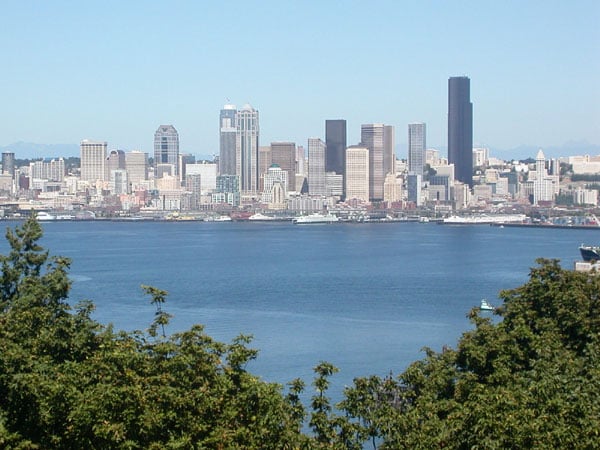
Pull into the gravel turnout on SW Admiral Way where it crests the ridge above Belvidere, and you'll see the same thing thousands of people photograph every year: Elliott Bay, the downtown skyline, and on a clear day the Olympics behind it. Most people glance at the tall wooden pole standing near the railing, assume it's been there forever, snap their photo, and drive on toward the Junction or down to Alki.
It hasn't been there forever. It's the third pole to stand on that spot since 1939, and the one many longtime Belvidere residents actually remember from childhood isn't gone. It's a mile away, fully restored, standing outside a museum near Alki Beach that most people driving past Belvedere Park have never walked into.
The park itself is a leftover. When city engineers laid out Admiral Way in the early twentieth century, the road climbed north and then bent west at the top of the ridge, leaving an odd 1.7-acre triangle of land nobody had planned for. That triangle became Belvedere Park, officially designated in 1932, named for the Italian word for beautiful view. The spelling has never quite settled: the park is Belvedere, the street one block over is Belvidere, and the neighborhood answers to both depending on who's talking.
The first pole arrived in 1939, brought to the viewpoint by West Seattle resident J.E. "Daddy" Standley, owner of Ye Olde Curiosity Shop on the downtown waterfront. It was a Bella Coola carving from the British Columbia coast, made originally for the tourist trade around 1901. By the mid-1960s it had decayed past saving.
Its replacement came from an unlikely pair of carvers: Boeing engineers Michael Morgan and Bob Fleischman, who cut a cedar log from Schmitz Park and carved a close replica of the original in 1966. That pole stood at the viewpoint for forty years, watching over the same skyline photos, until carpenter ants weakened it beyond repair and Seattle Parks and Recreation removed it in 2006.
The pole standing there now is the third, carved by Michael Halady, a fifth-generation descendant of Chief Sealth, from a 450 to 550 year old western red cedar salvaged from the Olympic Peninsula. It's been there since 2006, which means most people who've moved to Belvidere in the past two decades have only ever known this one.
Here's how the three line up:
Pole | Years at the viewpoint | Carved by | Material | Where it is now |
|---|---|---|---|---|
First | 1939 to 1966 | Bella Coola carvers, British Columbia (circa 1901) | Traditional cedar, made for trade | Removed due to decay |
Second | 1966 to 2006 | Boeing engineers Michael Morgan and Bob Fleischman | Cedar log cut from Schmitz Park | Restored, on display outside the Log House Museum since June 2014 |
Third | 2006 to today | Michael Halady, fifth-generation descendant of Chief Sealth | Western red cedar, 450 to 550 years old, Olympic Peninsula | Standing at Belvedere Viewpoint |
Ask anyone who stops at the pullout what they're looking at and most will say totem pole. Halady, the carver, would correct them. Duwamish tradition never included totem poles. What Duwamish carvers made were house posts: shorter, structural pieces that supported longhouses while also telling a story through their carving.
That's what stands at Belvedere Viewpoint now, more accurately called a story pole. Its five figures read bottom to top: a welcoming figure representing Duwamish hospitality toward the Denny Party and the settlers who followed, the schooner Exact that carried them to Alki in 1851, three faces representing the Duwamish Tribe, a seated figure representing Chief Sealth, and at the top a Salish thunderbird.
Halady wanted the carving to do more than fill the space the old pole left behind. As he put it at the time,
"I wanted to let them know the Duwamish are here."
The distinction matters because the Duwamish Tribe still isn't federally recognized, and a story pole standing at one of the city's most photographed viewpoints is one of the few places that history gets told without anyone having to look it up.
The 1966 Boeing-engineer pole didn't end up in a landfill or a storage yard. Seattle Parks and Recreation handed it to the Southwest Seattle Historical Society, which spent years and worked with Artech Fine Art Services to restore it. On June 6, 2014, the restored pole was unveiled outside the Log House Museum, with Duwamish tribal members and students from Alki and Schmitz Park elementary schools on hand for the ceremony.
It stands there today, facing east along 61st Avenue SW, one block south of Alki Beach, where the Denny Party landed on November 13, 1851 and the city of Seattle effectively began.
So the two poles that once occupied the same six-foot footprint at the top of Admiral Way are now telling their stories a mile apart:
Neither location tells you the other exists. You'd need to already know the history, or read a historical marker page, to realize you're looking at one half of a story that finishes somewhere else entirely.
If you live in Belvidere, you've probably driven past both spots dozens of times without connecting them. The route between them is the same one most people already take to get to Alki: down Admiral Way from the viewpoint, past the Admiral Junction, and out toward the water.
A version of that trip worth taking on purpose looks something like this:
The Log House Museum, run by the Southwest Seattle Historical Society, keeps regular hours and has more on the restoration if you want the fuller account than a turnout sign can give you.
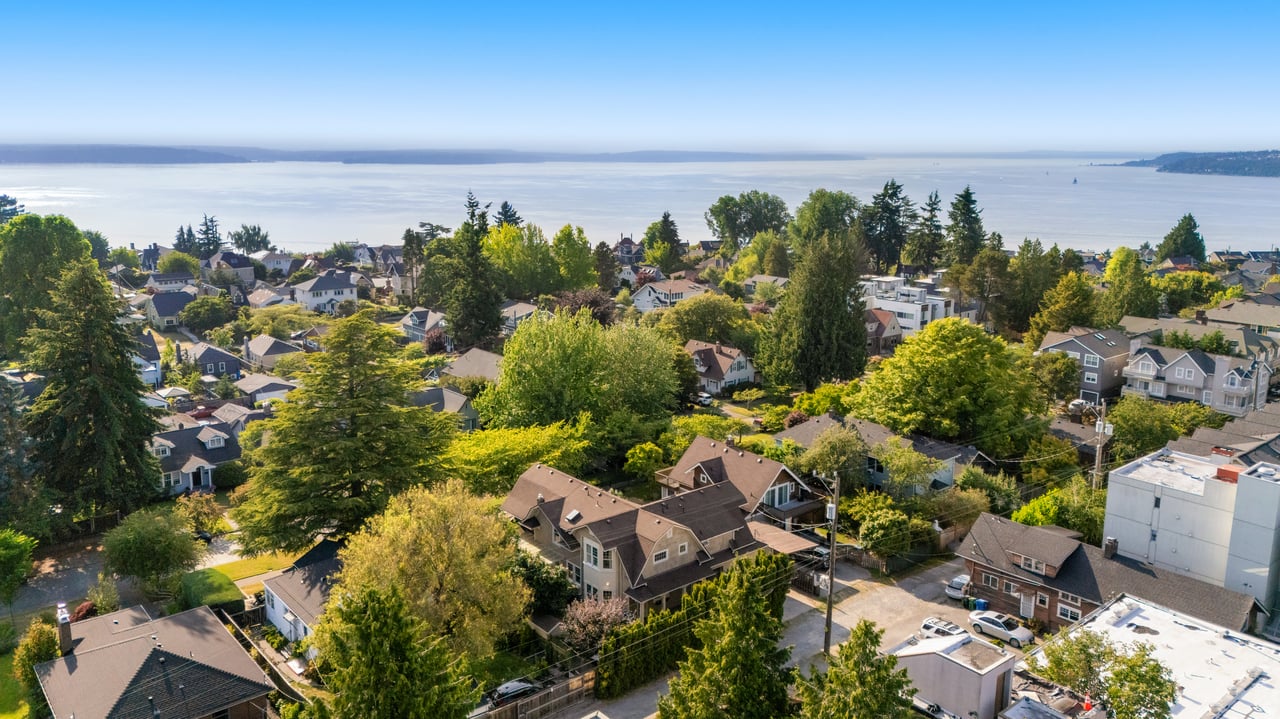
Belvidere gets described, accurately, as a quiet hilltop pocket of Craftsman and Tudor homes with unmatched skyline views. That's all true, and it's the version of the neighborhood most people already know. What's easy to miss is that the neighborhood's single most photographed landmark has been rebuilt twice, corrected in its own terminology, and split across two sites without most residents ever noticing.
That's worth knowing simply because it's true and because it changes what you're looking at the next time you pull over for the view. It's also a small example of something bigger about Belvidere: a neighborhood that looks static from the street corner has more layered history under it than the view alone suggests, which tends to be the case with most of West Seattle's older ridgeline pockets.
If you want the fuller neighborhood picture, from the boundary streets to the parks that anchor it, Mara Haveson's Belvidere guide covers the rest of what makes this stretch of the ridge worth knowing.
And if a landmark you drive past every week can hold this much history without most people noticing, it's worth asking what else in West Seattle deserves a second look. That's the kind of local curiosity Mara Haveson brings to every conversation about this market, whether you're asking about a story pole or a street's sale history. Reach out anytime you want to talk through either one.

Address
4531 California Ave., SW
Seattle, WA 98116
Mara Haveson