More Blog Posts
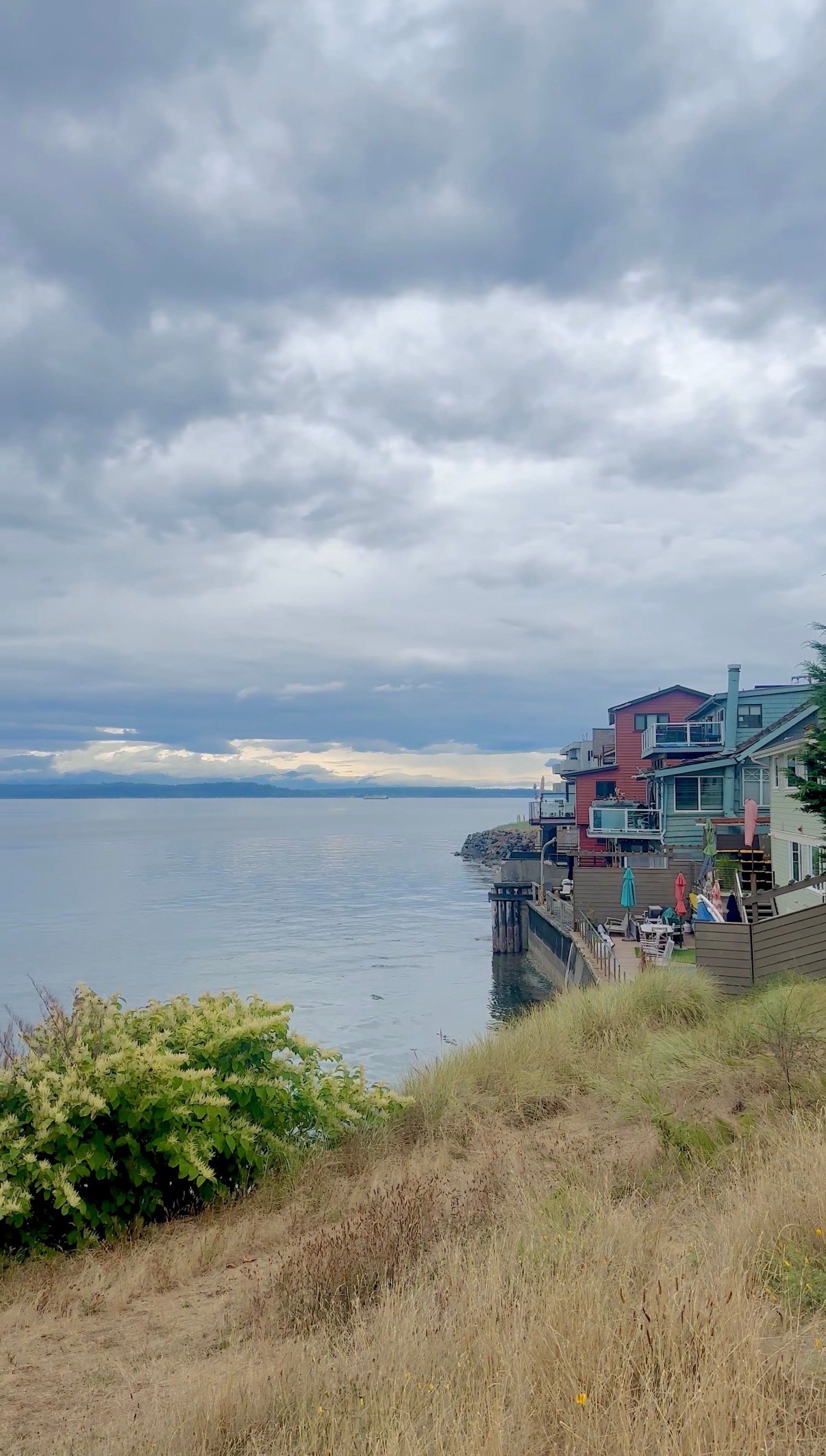
Two houses sit fifty feet apart on Beach Drive SW. Same view of the Olympics, same salt in the air, similar square footage, listed within a few hundred thousand of each other. One owner can walk out at minus tide and stand on land they hold in fee. The other owns to a line drawn by the tide itself and leases the water in front of their bulkhead from the state. That gap does not show up in the photos, and it barely shows up in the listing remarks. It is, however, most of what you are actually buying.
If you are comparing Beach Drive SW listings against Alki condos or the rest of West Seattle waterfront, the first thing worth understanding is that the numbers you are seeing on the portals are averaged across products that have almost nothing in common.
As of mid-2026, there are eight active listings on Beach Drive SW ranging from roughly $400,000 to $2.295M, with a trailing six-month single-family median around $1.928M, median size near 2,230 square feet, and median price near $864 per square foot at roughly three sales per month. That single-family number tells one story. The broader "West Seattle waterfront" median list price sits closer to $775K, because it folds in Alki condos and Harbor Avenue units at wildly different price points.
For context on how far apart the products are on this one street: a recent Beach Drive SW single-family listing at 5079 Beach Drive SW sits near $1.95M, while a four-bedroom unit at the Harbor West condo building at 3717 Beach Drive SW #304 lists around $1.25M. Same address prefix. Different asset entirely.
The takeaway is not that one is a better deal. It is that "average price on Beach Drive" is a number that will not survive contact with an actual offer. What determines value on this strip is not square footage. It is the rights and restrictions attached to the shoreline in front of the house.
Three terms decide almost everything, and the listing sheet rarely defines them.
Ordinary high water mark (OHWM). A physical line on the ground, identified by vegetation change and tide marks, that separates upland ownership from state aquatic lands. It moves. Accretion and reliction can grow an upland parcel over decades; erosion can shrink it.
Tidelands. The band between the OHWM and the extreme low water. In Washington, the state sold roughly 70% of its tidelands to private upland owners between statehood and 1971, which is why Beach Drive lots vary so dramatically. Some deeds run to the OHWM only. Some include tidelands in fee. A few include second-class tidelands going out to extreme low water. Listing language like "55 feet of Puget Sound waterfront bulkhead, including shorelands and tidelands" or "50 feet of rare, no-bank waterfront" exists precisely because the default is not that.
DNR aquatic lease. Where the state owns the tidelands or bedlands, an upland owner who wants a dock, buoy, float, or pier typically has to lease that aquatic land from the Washington Department of Natural Resources. Leases have terms, rent, and renewal schedules. A "permitted buoy" in a listing is not a decoration. It is a signed instrument with a counterparty.
Before you write an offer on Beach Drive, ask the listing broker for the recorded deed, any DNR lease, and any recorded shoreline permits. If the answer is "we can get those," the seller has not done the pre-listing work you would expect on a property at this price band.
Most Beach Drive homes sit behind a bulkhead of some age. Buyers assume that if there is one now, there will be one when they need to replace it. That assumption has been getting weaker for a decade.
Under Seattle Municipal Code 23.60A, a "normal protective bulkhead" for an existing single-family residence is exempt from a Shoreline Substantial Development Permit if it is at or near the OHWM and built to protect the existing home from erosion. Exempt from the permit is not exempt from the code. The 2015 Shoreline Master Program update requires that new or expanded hard armoring only be allowed where a geotechnical study demonstrates that softer solutions are not feasible and that adjacent soft shorelines will not be harmed.
Add to that federal jurisdiction. The Army Corps of Engineers expanded its regulatory line up to the high tide line, which as Puget Sound Institute reported brings most proposed bulkhead projects under Corps review and Endangered Species Act consideration for salmon and forage fish habitat. WDFW has also been given expanded authority over single-family bulkhead construction.
What this means during a transaction:
If you are looking at a home with an aging concrete or timber wall, the inspection to prioritize is not the roof. It is the toe of the bulkhead at low tide, plus a document search for any prior shoreline permit or exemption.
Beach Drive is not a marina strip. Most homes do not have private docks. But permitted buoys and stair-and-beach access improvements do show up, and they carry embedded value that is easy to miss.
The buyer of a Beach Drive property with a permitted buoy is buying three things: the upland, the improvement, and the ongoing lease relationship with the state that keeps the improvement legal. Only two of those show up on a home inspection.
Ask specifically: Is there a DNR lease? When does it expire? Are the rent payments current? Was the buoy installed under a Hydraulic Project Approval from WDFW? Was Army Corps authorization obtained? Beach stairs across an ECA slope are another quiet friction point, since Seattle's Environmentally Critical Areas rules require their own exemption process on top of shoreline review.
Washington's Seller Disclosure Statement, required under RCW 64.06.020 and known as Form 17, contains a specific environmental question at line 4.D asking whether there are shorelines, wetlands, floodplains, or critical areas on the property. On Beach Drive, the honest answer is almost always yes. Seattle's Shoreline District extends 200 feet inland from Puget Sound, which covers essentially every parcel on the west side of the street and most on the east.
A "yes" here is not a red flag. It is baseline. What matters is what the seller attaches to the disclosure: shoreline exemption records, geotech reports, bulkhead permits, DNR lease documents, HPA approvals, and any prior Corps correspondence. Buyers have three business days after receiving Form 17 to rescind the agreement in writing. If a Beach Drive Form 17 arrives with 4.D checked yes and no supporting documents, that three-day window is the time to send a document request, not to walk.
Sellers on this street who prepare their Form 17 alongside their pre-listing document set close cleaner and rescind less often. It is one of the few pieces of leverage a well-prepared seller has in a slow-moving segment.
A seller who can hand you all nine of these on request is priced for a reason. A seller who cannot is priced for a different reason.
Does every Beach Drive SW home come with private beach rights? No. Ownership varies parcel to parcel because of how Washington conveyed tidelands historically. Some homes own to the OHWM only, some hold tidelands in fee, and a handful have deeded rights that include first-class tidelands out to extreme low water. Read the deed, not the listing remarks.
Can I replace the existing bulkhead with a similar wall? Sometimes, and only if it qualifies as normal repair under SMC 23.60A. If the wall has failed enough that the OHWM has moved landward, or if the project counts as a new or expanded structure, geotechnical justification and soft-shore feasibility analysis are typically required, along with federal review.
Are the condos on Beach Drive comparable investments to the single-family homes? They are different products. Harbor West and other condo buildings on the street offer waterfront access without the shoreline maintenance burden, at a lower absolute price. The single-family stock on Beach Drive carries the shoreline responsibility and, historically, the appreciation profile that comes with limited-inventory waterfront lots.
What public beaches are nearby if I want to test the daily experience before buying? Cormorant Cove, Andover Place, Weather Watch Park near Alki Point, Me-Kwa-Mooks Natural Area, Lowman Beach Park, and the 135-acre Lincoln Park at the south end all offer public shoreline access along or near Beach Drive SW. Walking the strip at a minus tide tells you more about the neighborhood than any spreadsheet.
If you are weighing a Beach Drive SW purchase or preparing to list a home along this shoreline, the difference between an offer that closes and one that unwinds usually comes down to the documents nobody asked for until day 22 of escrow. Schedule a consultation with Mara Haveson to walk through the deed, the shoreline file, and the pricing story your listing actually tells.

Address
4531 California Ave., SW
Seattle, WA 98116
Mara Haveson